
Use Case Specific Requirements
Authored by:


Separating Multisigs by Function
Protocols should not consolidate all admin privileges into a single multisig. If one multisig controls everything (treasury, protocol upgrades, operational parameters, emergency pause), then compromising that multisig means total protocol compromise.
Why Separation Matters
- Blast radius: Separate multisigs limit the damage from any single compromise to one functional area
- Right-sized security: Different functions have different risk profiles. Routine parameter changes need different thresholds and response times than contract upgrades. Separate multisigs allow tailored security per function.
- Signer expertise: Protocol upgrade signers need deep technical expertise. Treasury signers need financial operations expertise. Separation puts the right people on each function.
Common Separation Patterns
| Function | Typical Threshold | Timelock | Notes |
|---|---|---|---|
| Protocol upgrades | High (e.g., 7/9+) | Long (7-14+ days) | Highest security, infrequent use |
| Operational parameters | Moderate (e.g., 3/5) | Medium (48-72 hours) | Routine tuning within bounds |
| Emergency pause | Lower (e.g., 2/4) | None | Constrained to pause-only actions |
| Treasury | High (e.g., 4/7) | Varies | Separate signer set from protocol admin |
| Specialized subsystem | Moderate | Medium | Domain-expert signers (e.g., oracle config, bridge params) |
Implementation Guidance
- Document which multisig controls which contracts and roles in the Registration Template
- Use separate on-chain roles (e.g., OpenZeppelin AccessControl) mapped to separate multisigs
- No single multisig should have both "pause" and "upgrade" capabilities unless the upgrade path is gated by a timelock
- Use dedicated signing keys per multisig so signers can easily distinguish which multisig a transaction belongs to, and so attackers cannot reuse compromised keys across multisigs
Treasury Multisigs
Key requirements:
- Allowance module required for all multisigs (see Modules & Guards)
Hot/Cold Wallet Separation
- Hot wallet must be used as an intermediary for treasury wallets
- Cold wallet must store the majority of assets
- Only basic transfers to the hot wallet address allowed
- Hot wallet must have a minimum 2-of-3 signer quorum
Wallet Segregation
- Very high value assets must be distributed amongst separate wallets to prevent potential loss of all assets
- At least 3 equally funded cold wallets are recommended
- Segregated wallets should be managed by different multi-sigs
- Seldom used wallets should have increased time-lock periods
- Any activity on seldom used wallets should trigger alerts to the entire team
External Signer Requirements
- Multi-sigs managing high value wallets and contracts should have at least 1 additional required signer that is external to the organization (such as a security partner or trusted advisor)
External Transaction Monitoring
- A third party outside of the organization should be set up to monitor time locked transactions for anomalies and unintended transaction effects
- The external monitor must perform transaction simulation of all pending transactions
- Monitor reports must be delivered at least 48 business hours before the time lock for a transaction lapses in order to provide adequate time to respond in the event of an anomaly
Emergency response Multisigs
Training & Drills:
- Bi-annual paging system tests to verify alert functionality
- Annual full emergency simulation with all signers
Additional requirements:
- Geographic distribution encouraged for 24/7 coverage
- 24/7 availability for threshold number of signers
Capital allocation Multisigs
Operational constraints:
- Encourage on-chain constraints wherever possible (smart contract limits, parameter bounds)
- Protocol expertise required for all signers
Smart contract control Multisigs
On-chain constraints:
- Timelock contracts for major changes (upgrades, significant parameter changes)
- Parameter limits enforced by smart contracts where feasible
Threshold considerations:
- Higher thresholds for contract upgrades (consider 7/9+)
- Lower thresholds acceptable for highly constrained operations (rate setting with bounds and a backup recovery mechanism to replace the multisig)
Timelock Configuration
Timelocks are essential for any multisig controlling protocol parameters, upgrades, or user-facing configuration. A multisig without a timelock means that once threshold signatures are collected, changes take effect immediately with no opportunity for detection or intervention.
Use a timelock contract (e.g., OpenZeppelin Timelock Controller) to stage transactions on-chain for final verification before execution.
Why Timelocks Are Critical
Without a timelock, the only defense is that the threshold number of signers are all honest and careful at all times. This is a fragile assumption. Timelocks create a public review window: once a transaction is queued, anyone monitoring the chain can see what is about to happen. This enables detection of malicious or incorrect proposals before they execute.
Timelocks are only effective if someone is actively watching. See Timelock Monitoring below.
Tiered Timelock Durations
Not all changes carry the same risk. Protocols should use different timelock durations based on the severity of the change:
- Long (7-14+ days): Major changes that affect user funds or fundamental protocol behavior such as contract upgrades, token contract changes, or reward distribution changes. Users need time to react (e.g., withdraw funds or unbond stake).
- Medium (48-72 hours): Significant operational changes such as fee parameter updates, validator set configuration, or oracle changes. The team and external monitors need time to review.
- Short (hours to 1 day): Routine parameter adjustments within predefined bounds. Still provides a verification window without impeding normal operations.
- No timelock (direct execution): Reserved only for emergency actions that are highly constrained in scope (e.g., pause-only capability). See Design Principles.
The appropriate duration depends on how much time users need to react, the potential impact if the change is malicious, and the operational cadence of the change.
Configuration
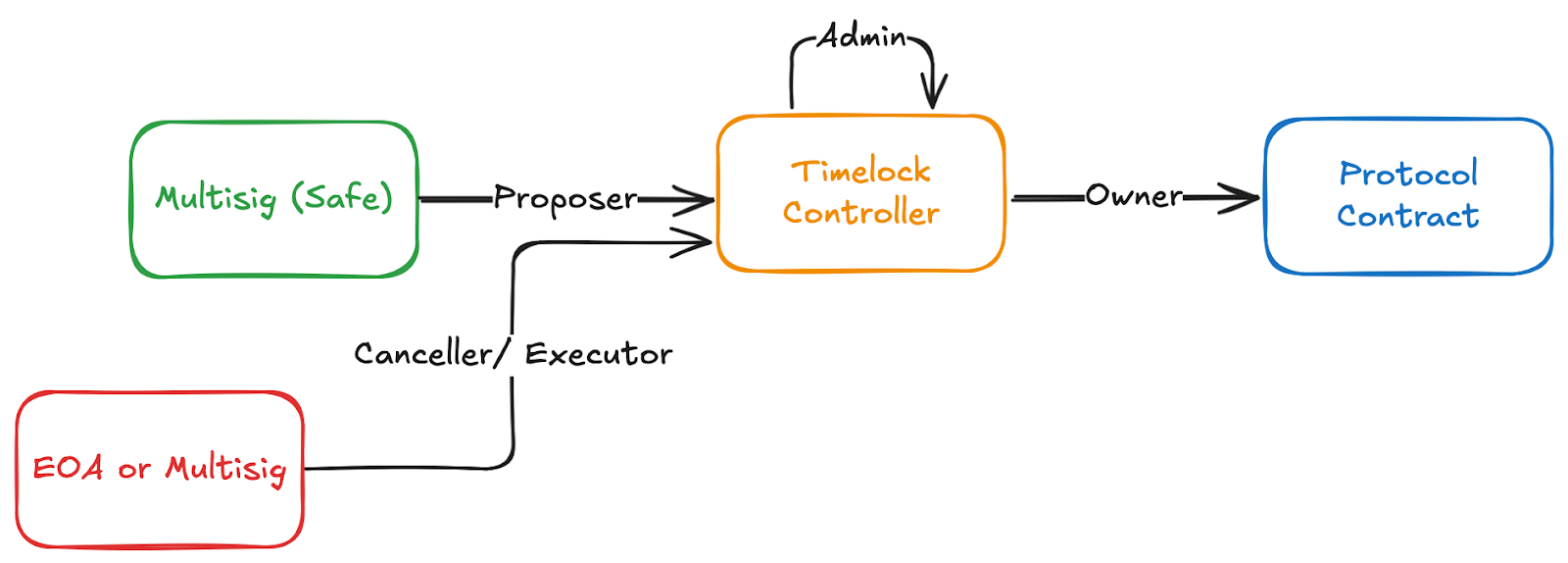
When using a timelock contract the timelock address will be set as the owner or role-holder for the protocol contract. The Safe will be the sole contract that has the Proposer role on the timelock contract. The Safe, or an address of a multisig signer, or other desired EOA can be set as the canceller or executor on the timelock contract. By default the timelock contract is set to be its own admin. This means that any changes to timelock contract roles also go through the timelock stage.
Veto Quorum
- Establish a smaller veto group separate from the confirmation quorum to review and confirm transaction legitimacy
- Organizations can establish veto quorums to bypass time-locks in case of emergency
- The standard quorum plus two additional signers should be required to bypass
Recommended Time-Lock Delays
As a default, time-locks should delay transactions a minimum of 3 days. Use the tiered approach above to adjust based on the type of change. Even a short delay (e.g., 1 hour) with active monitoring is significantly better than no delay at all.
Simulation Consideration
When using a timelock the simulation for the multisig transaction will not show the execution of the transaction but instead the addition of the pending transaction to the timelock. The pending transaction can be simulated manually as shown in Simulation testing.
Timelock Monitoring
A timelock without active monitoring provides no protection. If no one watches for queued transactions, a malicious proposal will simply execute after the delay period. The monitoring window IS the security mechanism.
Requirements
- Automated alerting: Implement monitoring that watches for all timelock events (
CallScheduled,CallExecuted,Cancelled, or equivalent) and immediately alerts the multisig signer team and external monitors - Decoded transaction details: Alerts should include the full decoded transaction details (target contract, function, parameters), not just a notification that something was queued. This allows reviewers to quickly assess whether the transaction is expected and correct.
- Response procedures: Document what to do when a timelock alert fires: who reviews it, how it is verified as legitimate, and how to cancel if it is malicious or incorrect
- External monitoring: At least one monitoring channel should be operated by a party external to the core team, so that an internal compromise cannot suppress alerts. See External Transaction Monitoring for treasury-specific requirements.
- Redundant channels: Use multiple independent alert channels (e.g., email, Slack, Telegram) so that a single channel failure does not cause a missed alert
Community Visibility
Consider making timelock queues publicly visible through a dashboard or notification feed. This allows the broader community to observe pending changes, which adds an additional layer of scrutiny beyond the core team.